
Description
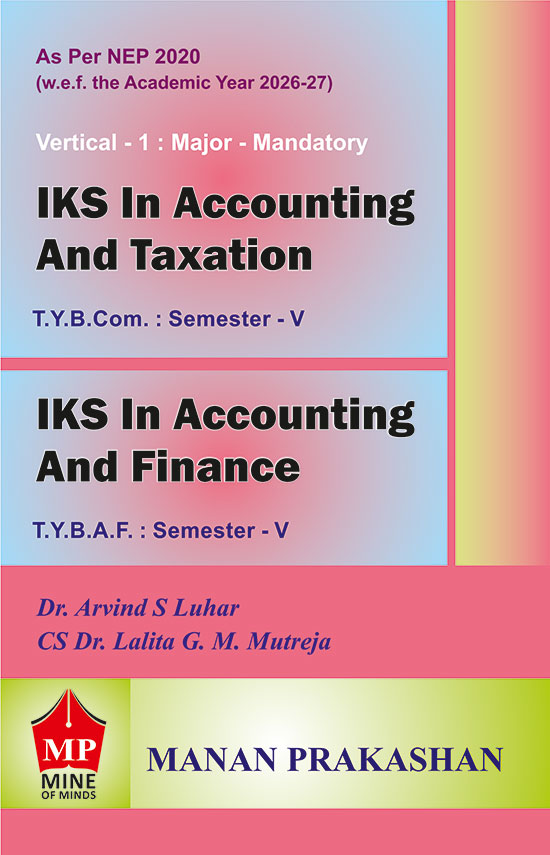
IKS in Accounting and Taxation
TYBCOM Semester V
T.Y.B.A.F. Semester V : IKS in Accounting and Finance
Vertical – 1 : Major – Mandatory
As Per NEP 2020 (w.e.f. the Academic Year 2026-27)
Syllabus
Module 1 : Public Financial Administration and Ethical
Governance : Insights from Kautilya’s Arthashastra
A. Expenditure and Budgeting
♦ Principles of Public Expenditure
♦ Budget Preparation and Control Mechanisms
♦ Salary Administration, Maintenance of Storehouses, and Acquisition of Valuables
B. Auditing and Internal Controls
♦ Annual Accountability Reports and the Closing of Books
♦ Role and Process of Royal Auditors
♦ Audit Procedures : Submission of Sealed Accounts, Prohibition of Collusion, and Annual Audits at the end of the Financial Year (Full Moon of Asadha)
♦ Internal Controls to Prevent Fraud and Misuse of Resources
C. Organizational Design and Ethics
♦ Codification of Financial Rules and Regulations
♦ Organizational Structure to Minimize Conflicts of Interest
♦ Role of Ethics in Accounting, Prevention of Corruption, and Maintenance of Law and Order
D. Contemporary Relevance and Comparative Analysis
♦ Application of Kautilya’s Principles in Modern Accounting and Governance
♦ Comparative Study with Current Indian Government Finance Systems
♦ Lessons for Modern-Day Financial Administration
Module 2 : Taxation Systems in Ancient India
A. Concept and Rationale of Taxation in Indian Knowledge Systems
♦ Taxation as Rajadharma and Lokasangraha
♦ State Responsibility, Welfare Orientation, and Redistribution
♦ Ethical Limits on Taxation and Protection of Taxpayers
B. Principles of Taxation and Public Administration
♦ Equity, Certainty, Convenience, and Economy in Indian Thought
♦ Accountability of the Ruler and Revenue Officials
♦ Overview of Partial and General Tax Incidence in Traditional Economies
C. Taxation in Classical Indian Texts
♦ References to Taxation in the Ramayana and Mahabharata
♦ Manu Smriti : Moderation, Fairness, and Social Order
♦ Kautilya’s Arthashastra : Systematic Revenue Framework, Tax Administration, and Welfare Measures
D. Taxation and Revenue Administration in Ancient India
♦ Mauryan Revenue System
– Land Revenue, Trade Taxes, State Monopolies
– Centralised Fiscal Administration
♦ Gupta Revenue System
– Land Grants, Decentralisation, and Revenue Remission
♦ Chola and Vijayanagar Fiscal Practices
– Local Self-Governance and Taxation
– Temple-Centred Revenue Management
– Trade, Irrigation, and Land-Based Taxes
E. Taxation in Medieval India
♦ Sultanate Period
– Iqta System
– Agricultural Taxation and Market Control
♦ Mughal Administration
– Todar Mal’s Land Revenue Reforms
– Zabt System and Assessment Techniques
– Balance Between Revenue Efficiency and Agrarian Stability



Reviews
There are no reviews yet.